Training Macrophages to Fight Cancer
The tumor microenvironment poses a massive barrier to the effectiveness of cancer immunotherapy. Due to the plasticity of macrophages to exert either pro- or anti-tumor effects, there is growing interest in reprogramming these cells to help fight cancer.
September 30, 2026
Introduction
The tumor microenvironment poses a massive barrier to the effectiveness of cancer immunotherapy. Due to the plasticity of macrophages to exert either pro- or anti-tumor effects, there is growing interest in reprogramming these cells to help fight cancer. As we know, the adaptive immune system, such as B and T cells, have “memory” and can recall previously encountered pathogens. Interestingly, innate immune cells can also acquire a memory-like response that can enhance defense against secondary challenges. This concept garners historical significance, as William Coley, the “Father of Cancer Immunotherapy,” discovered that stimulating the immune system with bacterial components, which induce innate immune memory, was an effective treatment against cancer1. Despite this phenomenon, the molecular mechanisms by which exposure to bacterial components such as lipopolysaccharide (LPS) reprogram macrophages and promote anti-tumor effects, had not been explored.
Goals of this Study
This study aimed to determine the metabolic and epigenetic mechanisms underlying innate immune memory in the context of anti-tumor immunity. In this study, the authors used a mix of in vivo murine models and in vitro bone marrow-derived macrophages to parse out the mechanism of trained immunity. Due to the intimate link between metabolism and chromatin remodeling and epigenetic memory, they end up focusing on glutamine metabolism because of the product alpha-ketoglutarate (α-KG), a critical co-factor for chromatin-modifying enzymes.
The authors first demonstrated that treating mice with LPS before tumor implantation suppressed tumor growth and promoted a more favorable anti-tumor microenvironment, characterized by increased cytokine production, enhanced cancer cell phagocytosis, and more functional cytotoxic CD8+ T cells. These observations were also confirmed in in vitro macrophage cultures. Furthermore, experiments using immunodeficient mice, macrophage-depleted mice, and mice that received adoptively transferred trained macrophages collectively demonstrated that macrophages alone were sufficient to control tumor growth.
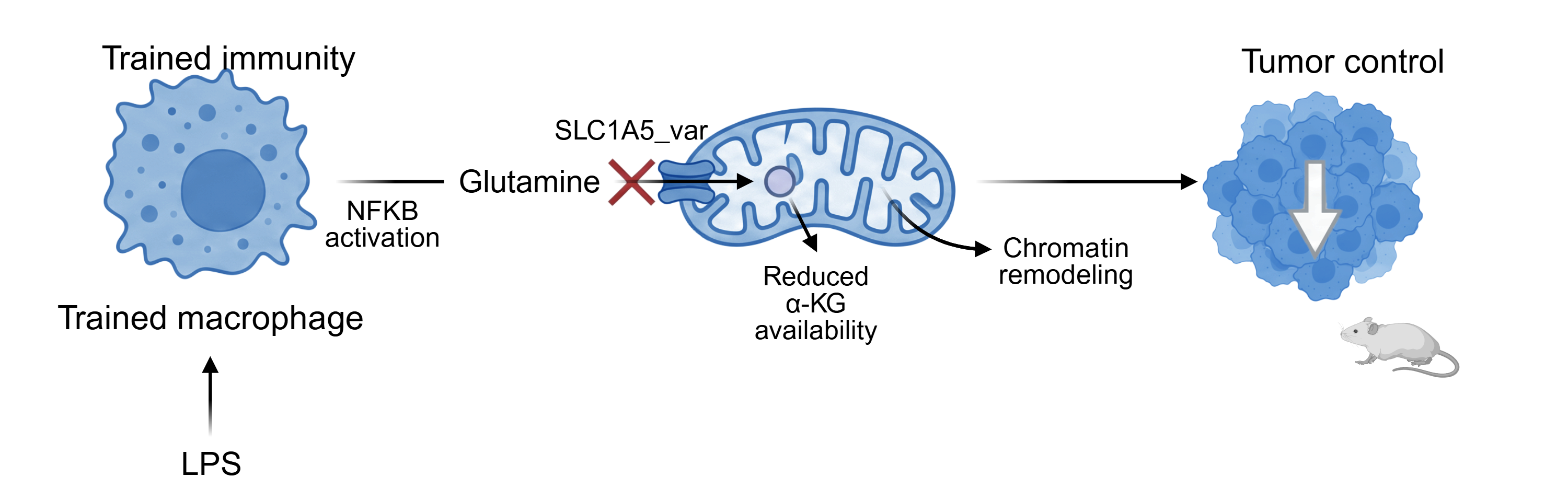
The authors next found that glutamine metabolism was suppressed in trained macrophages, accompanied by increased glycolysis. This metabolic shift was further characterized using nutrient-tracing and metabolic assays, which revealed reductions in glutamine-derived metabolites and decreased cellular respiration. Importantly, the SLC1A5 isoform, SLC1A5_var, a mitochondrial glutamine transporter, was downregulated, and this was controlled by NF-KB. Because they saw reductions in metabolite α-KG, the authors also examined the epigenetic landscape. Consistent with this hypothesis, the active chromatin mark H3K4me3 level was preferentially increased in trained macrophages but were reduced when SLC1A5_var was overexpressed. The authors further mapped these H3K4me3-enriched regions to genes involved in inflammatory responses. By overexpressing SLC1A5_var, the authors were able to show that in trained macrophages, suppression of glutamine metabolism, by NK-KB-mediated downregulation of SLC1A5_var, reduced α-KG availability. Because α-KG serves as a cofactor for histone demethylases, lower α-KG levels impair H3K4me3 removal, resulting in increased chromatin accessibility at inflammatory gene loci. Consequently, trained macrophages adopt a more pro-inflammatory phenotype with enhanced anti-tumor activity
This paper was rigorous and clearly defined a mechanism linking LPS-induced trained immunity in macrophages to tumor control. In theory, these findings could have important clinical implications; however, the safety and feasibility of using bacterial components or their derivatives to therapeutically reprogram macrophages to fight tumors remain largely unexplored. It is also important to note that the entire study was conducted in mouse models and murine cells, so whether this mechanism is conserved in human cancer models needs to be investigated.
Article title: “Macrophage trained immunity requires a mitochondrial glutamine-restriction checkpoint for antitumor protection in mice.”
Article Reference: Yu YC, Sung Y, Lim S, Kwon JA, Lee MJ, Kim HY, Kim S, Kim K, Min DS, Yoo HC, Han JM. Macrophage trained immunity requires a mitochondrial glutamine-restriction checkpoint for antitumor protection in mice. Nat Commun. 2026 Aug 15;17(1):9805.
Additional References
Coley,W.B. Treatment of inoperable malignant tumors with the toxins of erysipelas and the bacillus prodigiosus. Am.J.Med.Sci. 108, 50 (1894).
Figure created in BioRender