Stress Impairs Intratumoral B cells
Cancer progression is driven by multiple factors that are beneficial under normal conditions. Chronic stress is associated with cancer progression and metastasis, and can suppress the adaptive immune response, a critical component of anti-tumor immunity.
July 18, 2026
Introduction
Cancer progression is driven by multiple factors that are beneficial under normal conditions. Chronic stress is associated with cancer progression and metastasis, and can suppress the adaptive immune response, a critical component of anti-tumor immunity.
Stress hormones, particularly glucocorticoids, are synthesized by the adrenal cortex through activation of the hypothalamic-pituitary-adrenal (HPA) axis and the sympathetic nervous system. In addition to systemic production, glucocorticoids can also be produced by peripheral cells, including immune cells and tumor cells. These cells also express the glucocorticoid receptor, allowing glucocorticoids to exert broad effects on T cells, inflammatory monocytes, and the gut microbiota.
The gut microbiota is becoming increasingly recognized as a hallmark of cancer, yet the connection between chronic stress-induced effects on the gut microbiota and their impact on anti-tumor immunity has not been investigated. Additionally, whether chronic stress alters the gut microbiota in ways that impair anti-tumor immunity remains largely unexplored.
Because cancer immunotherapy aims to harness the immune system to eliminate tumors, understanding how stress influences immune cell function is of significant interest. B-cell-mediated anti-tumor immunity has emerged as an important determinant of immunotherapy response, and the B-cell repertoire is strongly shaped by the gut microbiota. Despite these connections, the relationship between chronic stress, stress-induced alterations of the gut microbiota, and the resulting effects on intratumoral B-cell responses had not been investigated until now.
Goals of This Study
This study, published in Cancer Cell, uncovers this previously unexplored connection using a chronic unpredictable mild stress model in which mice were exposed to common stressors prior to tumor implantation.
Mice under these stressful conditions developed larger tumors and had fewer germinal center B cells, along with increased corticosterone levels in the tumors. Similarly, antigen-specific B-cell responses were reduced in stressed mice compared to controls, and B cells isolated from stressed mice showed impaired metabolic reprogramming and differentiation.
Because the microbiota is closely tied to B-cell responses, the researchers treated mice with broad-spectrum antibiotics. This restored germinal center B cells in stressed mice and only induced a modest increase in plasma corticosterone levels. Together, these findings suggest a role for the microbiota in stress-induced stress hormone production.
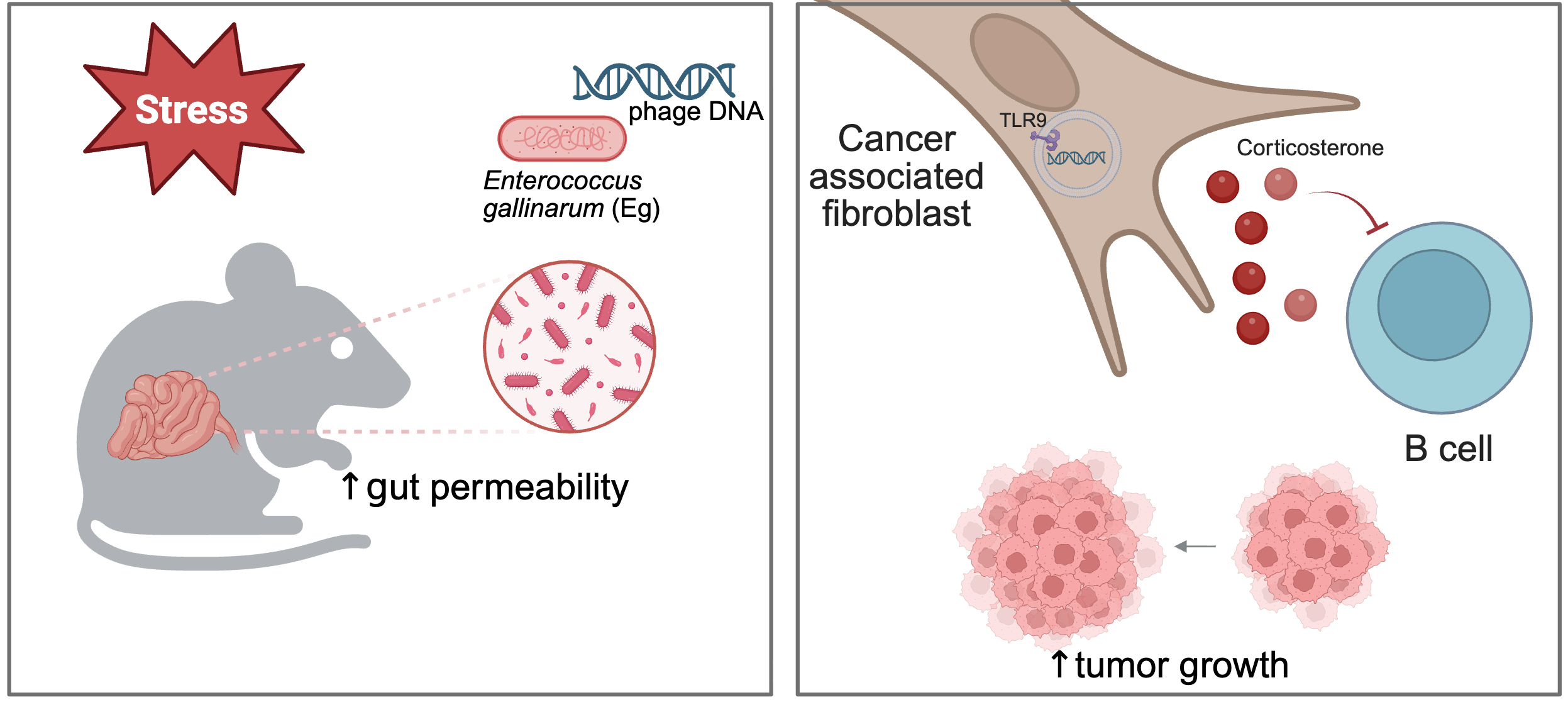
Next, the authors examined the intratumoral bacteria under stress and control conditions. Interestingly, they found that phage-carrying bacterial isolates from tumors in stressed mice were predominantly Enterococcus gallinarum (Eg).
To test whether E. gallinarum directly contributed to tumor growth, the researchers mono-colonized mice with Eg. Like the chronically stressed mice, the Eg-colonized mice exhibited accelerated tumor growth, fewer germinal center and plasma B cells, and higher intratumoral corticosterone levels.
Further investigation revealed that Eg DNA entering the tumor microenvironment activated Toll-like receptor 9 (TLR9) signaling in cancer-associated fibroblasts. These fibroblasts became the source of corticosterone production. Elevated corticosterone also increased gut permeability, allowing Eg DNA to escape the gut and enter the tumor environment. When the researchers induced low-grade chronic gut injury in mice, they observed similar accelerated tumor growth and reduced germinal center B cells, linking gut injury to chronic stress.
Finally, the authors investigated whether this pathway could be therapeutically targeted. Blocking TLR9 signaling or administering the antibiotic ampicillin reduced tumor growth and increased germinal center B cells, even in the chronically stressed mouse model.
Discussion
This was a very interesting paper to read because it was outside my primary field of cancer research. Additionally, the experimental models were thoughtfully designed and effectively answered the authors' questions, clearly linking chronic stress, the gut microbiota, and their effects on the tumor immune microenvironment and tumor progression.
The study also identifies a novel role for bacteriophage DNA in modulating immune responses within tumors. Although it is difficult to fully model human psychological stress in mice, this work highlights the importance of considering chronic stress in cancer patients and its potential negative effects on tumor progression and, likely, responses to immunotherapy.
Article Information
Article Title
Chronic stress unleashes an intratumor phage-fibroblast-B cell circuit to promote tumor growth.
Reference
Bashir H, Sanidad KZ, Ravisankar P, Banks KM, Bose A, Yu S, et al. Chronic stress unleashes an intratumor phage-fibroblast-B cell circuit to promote tumor growth. Cancer Cell. 2026 Jun 25:S1535-6108(26)00291-6. doi:10.1016/j.ccell.2026.06.004. Epub ahead of print. PMID: 42349430.
Figure
Figure created with BioRender.