How Scientists Are Using Living Micro-Robots to Fight Cancer
Mobile microrobots, which can be remotely controlled inside the body, have emerged as a promising new cancer therapeutic approach that could overcome limitations associated with traditional systemic administration methods1. However, because these microrobots were formerly produced from synthetic materials, they can induce unwanted immune responses due to the introduction of a foreign body into the organism.
May 9, 2026
Introduction
Mobile microrobots, which can be remotely controlled inside the body, have emerged as a promising new cancer therapeutic approach that could overcome limitations associated with traditional systemic administration methods1. However, because these microrobots were formerly produced from synthetic materials, they can induce unwanted immune responses due to the introduction of a foreign body into the organism. Furthermore, once these microrobots are localized to the tumor area, they are unable to distinguish cancer cells from healthy cells. One way that biological targeting could be achieved is through a cell-based therapy, as has been demonstrated with T cell-based therapies such as CAR-T cell therapy. However, the dependence on a single antigen expressed by cancer cells, as well as the necessity for direct cell-to-cell contact with the target cell, limits its efficacy in solid tumor microenvironments. By combining the capabilities of controlled microrobot delivery to the tumor region with the biological targeting advantages of cell-based therapies, these two approaches could yield a highly effective therapeutic system.
Goals of this study
The researchers in this study aimed to develop microrobots derived from human cells that could selectively target cancer cells while leaving healthy cells unscathed. This required targeting something that cancer cells overexpress, but normal cells do not. One well-studied secreted ligand, tumor necrosis factor-related apoptosis-inducing ligand (TRAIL), induces apoptosis, or cell death, when it binds to its cognate receptor, death receptor 4/5 (DR4/5). Fortunately, cancer cells typically overexpress this receptor, whereas healthy cells do not, which is why the researchers chose TRAIL as their therapeutic payload.
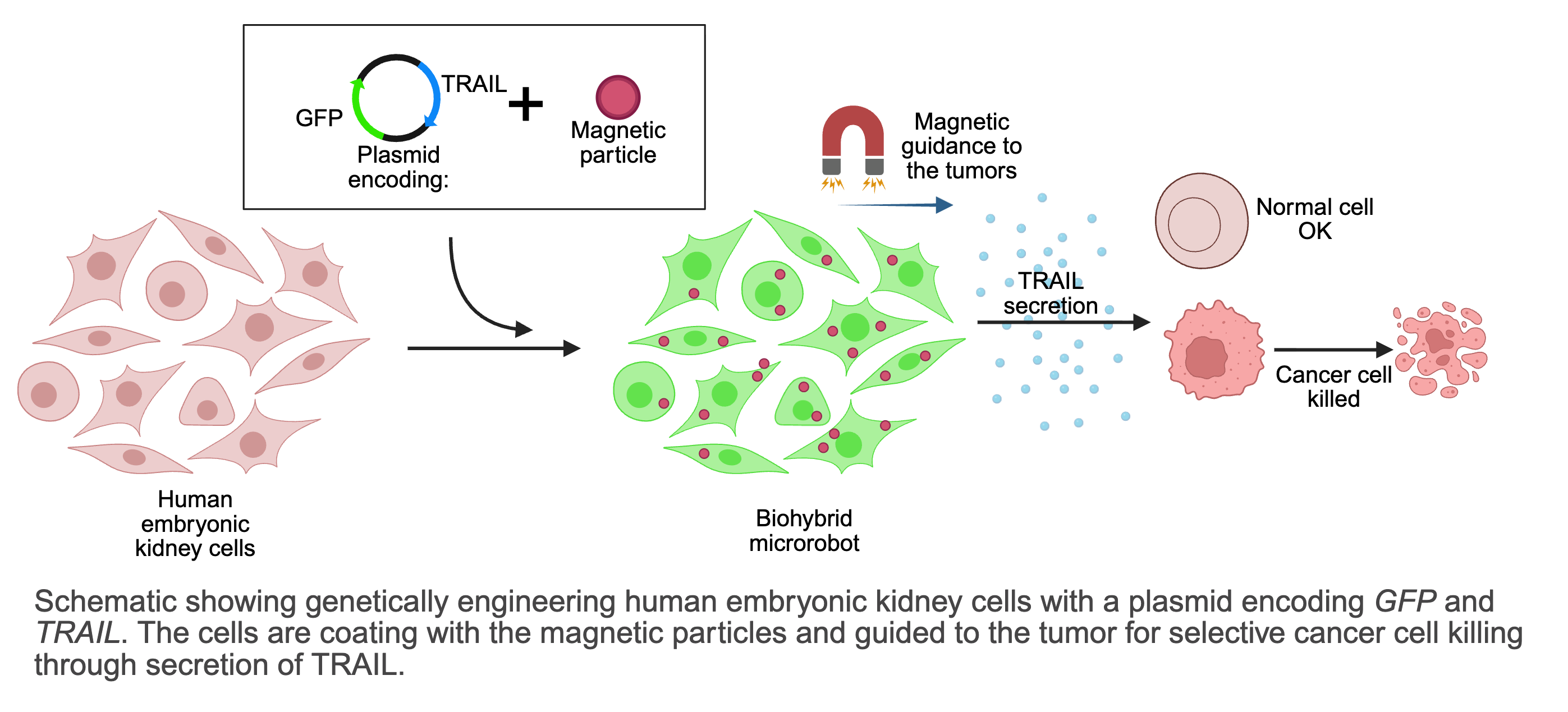
For their cell-based approach, the researchers engineered human embryonic kidney cells to express the TRAIL gene and green fluorescent protein (GFP) for visualization. To enable magnetic control, they added silica beads coated with iron-platinum magnetic nanofilm, which coated the cell membrane without harming the cells. Following careful characterization and optimization of these hybrid microrobots, they tested whether the microrobots could selectively kill cancer cells.
First, they assessed whether TRAIL secreted from the engineered microrobots could kill cancer cells without affecting healthy cells. To do this, they collected conditioned media and applied it to different cancer cell lines and healthy cell lines. Cell death was observed only in the cancer cells exposed to the conditioned medium. The researchers then moved to a transwell co-culture system, which allowed for cell-to-cell communication without direct contact. This experiment also demonstrated that the TRAIL-engineered cells selectively killed multiple cancer cell lines. Lastly, they moved to a more physiologically relevant model using three-dimensional (3D) tumor spheroids. After generating the tumor spheroids, they magnetically guided the microrobots toward the spheroids and demonstrated successful accumulation and tumor spheroid killing.
This cell-based approach overcomes the limitation of requiring direct cell-to-cell contact, which is necessary for many other cell-based therapies, while also enabling selective targeting of cancer cells over healthy cells. Another particularly interesting aspect of this therapeutic strategy is its immense flexibility in both the choice of cell type and therapeutic gene, which could allow this method to be adapted for other disease states. However, these microrobots have only been evaluated in cell culture studies and still require investigation in preclinical models to better assess their efficacy and determine the optimal route of delivery. Although this method enables magnetic guidance, it remains important to evaluate whether intratumoral, intravenous, or alternative routes of administration are both safe and effective. Nonetheless, this approach has the potential to overcome many of the obstacles commonly associated with solid tumor treatment strategies.
Article title: Genetically engineered human cell–based microrobots for selective cancer cell death
Article Reference: Nihal Olcay Dogan et al., Genetically engineered human cell–based microrobots for selective cancer cell death. Sci. Adv.12, eaea9831(2026). DOI:10.1126/sciadv.aea9831
Additional references
Iacovacci V, Diller E, Ahmed D, Menciassi A. Medical Microrobots. Annu Rev Biomed Eng. 2024 Jul;26(1):561-591. doi: 10.1146/annurev-bioeng-081523-033131. Epub 2024 Jun 20. PMID: 38594937.
Figure created with BioRender