Eat more plants! Equipping T cells to utilize the plant metabolite cellobiose in the glucose depleted tumor microenvironment.
Tumor cells greatly increase their glucose consumption to support their high metabolic demands. Unfortunately, infiltrating immune cells such as cytotoxic T cells also undergo metabolic reprogramming when activated, and require glucose to elicit their effector functions in the tumor.
March 31, 2026
Introduction
Tumor cells greatly increase their glucose consumption to support their high metabolic demands1. Unfortunately, infiltrating immune cells such as cytotoxic T cells also undergo metabolic reprogramming when activated, and require glucose to elicit their effector functions in the tumor. Depletion of glucose negatively impacts the anti-tumor functionality and survival of these T cells and therefore promotes tumor progression2. Exploring other energy sources for T cells to use could in theory reenergize these T cells as they will have their own exclusive energy source tumor cells cannot use.
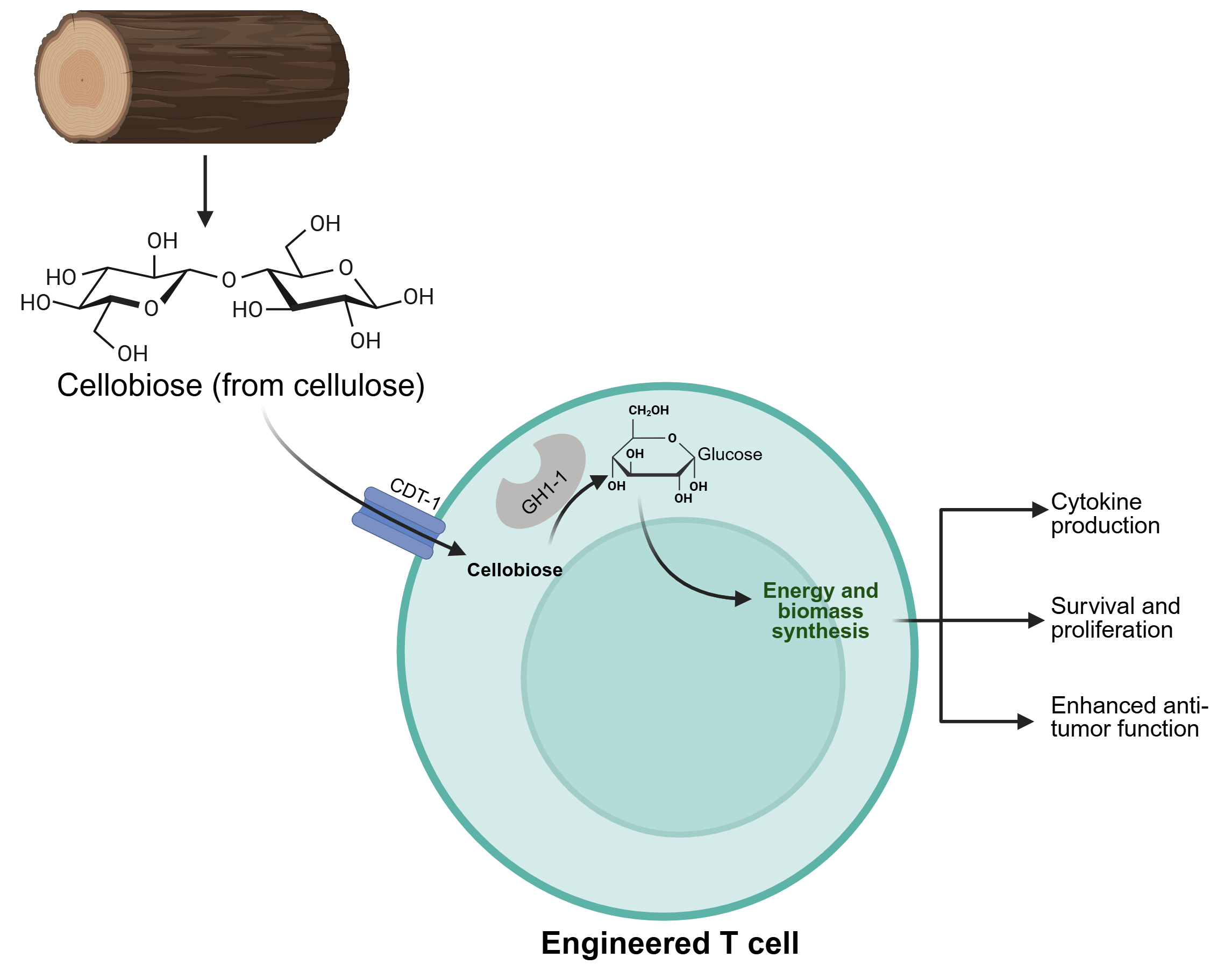
Cellobiose is a disaccharide found in the plant matter cellulose that can be broken down into glucose. However, animals can only transport monosaccharides and lack the proper enzymes to break this metabolite down into usable glucose. If mammalian cells could be engineered to express the transporter and enzyme to break down this plant metabolite, they could use cellobiose as an exclusive energy source. This would be especially useful to enhance efficacy of chimeric-antigen receptor T cell (CAR-T) therapy, where due to the nutrient-poor, hostile environment of solid tumors, has not shown promise in the clinic.
Goals of this study
The researchers’ overarching hypothesis was that if they could provide T cells the ability to utilize cellobiose, this would give them the glucose necessary to carry out their capacity to kill tumor cells when exogenous glucose is not abundant in the tumor microenvironment.
They first introduced the cellobiose transporter CDT-1 and the plant hydrolase GH1-1 into T cells. Next, they confirmed that these engineered T cells took up the cellobiose by measuring the intracellular amount of a radiolabeled C13-cellobiose, and that the presence of the hydrolase could increase intracellular glucose concentrations. They were also able to show that in the absence of glucose and presence of cellobiose, the engineered T cells could utilize the broken down cellobiose to feed into metabolic pathways that support energy and biomass needs. Furthermore, in these same conditions they showed that secretion of key cytokines such as IFNγ and TNFα and proliferation of these engineered T cells remains intact. Overall, this provided a proof-of-concept that when glucose was not available, cellobiose replenished these bioenergetic pathways and effector functions of the T cells.
Their next step was to move this to a preclinical model since the previous experiments were all in vitro. Using a few different tumor cell lines expressing ovalbumin, they implanted tumors, adoptively transferred these engineered OT-I T cells (this allows for antigen specific targeting), and then injected mice with either cellobiose or vehicle control. The mice that received cellobiose had smaller tumors and survived for longer compared to mice receiving vehicle control, indicating that the T cells were able to more effectively clear the tumor because they had their own unique energy source cellobiose.
They took this a step further to see if this could enhance therapeutic efficacy of CAR-T cells in their preclinical models. When the CAR-T cells were endowed with the ability to take up and break down cellobiose, they proliferated more and expressed higher levels of IFNγ and TNFα, which led to a trend in smaller tumors in cellobiose-treated mice.
Overall, this was a highly innovative approach to better equip T cells to fight the tumor. While engineered T cells like CAR-T cells have proven beneficial in hematological malignancies such as myeloma and leukemia, this therapy has not shown the same benefit in solid tumors due to barriers faced by these cells in the solid tumor microenvironment, one being the lack of glucose available3. This study paves the way for further exploring the therapeutic use for preventing nutrient competition, but it would have been nice to better characterize these T cells by assessing other important features of the engineered T cells, such as perforin and granzyme release. It would also be useful to look at how cellobiose could impact T cell memory formation. Lastly, while it is safe for patients to receive cellobiose, how much and how frequently they would need to receive this plant metabolite requires extensive investigation.
Article title: Fungal-derived cellobiose metabolic pathway fuels T cells to bypass intratumoral glucose competition.
Article Reference: Miller M, Thauland T, Nagarajan S, et al. Fungal-derived cellobiose metabolic pathway fuels T cells to bypass intratumoral glucose competition. Cell, 2026; 189, 1717-1730.e16
Additional references
Pavlova N, Thompson C. The Emerging Hallmarks of Cancer Metabolism. Cell Metabolism, 23, 27-47 (2016).
Chang C, Qiu J, O’Sullivan D et al. Metabolic Competition in the Tumor Microenvironment Is a Driver of Cancer Progression. Cell; 162, 1229-1241 (2015).
Lamplugh, Z.L., Wellhausen, N., June, C.H. et al. Microenvironmental regulation of solid tumour resistance to CAR T cell therapy. Nat Rev Immunol 26, 230–248 (2026).
Figure created with BioRender