Doubling Down: How Genomic Doubling Helps Breast Tumor Cells Hide from The Immune System
The presence of distinct subpopulations of tumor cells, termed intratumoral heterogeneity, is a common feature in solid tumors and represents a significant clinical challenge due to the selection of subpopulations with growth and drug-resistant advantages. These subclones are commonly aneuploid or contain abnormal chromosomal numbers. . .
June 2, 2026
Introduction
The presence of distinct subpopulations of tumor cells, termed intratumoral heterogeneity, is a common feature in solid tumors and represents a significant clinical challenge due to the selection of subpopulations with growth and drug-resistant advantages. These subclones are commonly aneuploid or contain abnormal chromosomal numbers. Aneuploidy can be caused by doubling of the entire set of chromosomes, or whole genome doubling (WGD). WGD is common in aggressive subtypes of breast cancer such as triple-negative breast cancer (TNBC) is associated with poorer patient outcomes and distant metastases. While aneuploid cells are normally recognized by the immune system and eliminated, in cancer these cells evade immune detection, suggesting immune escape mechanisms that have not yet been defined. A better understanding of these mechanisms could provide a basis for targeting tumors that contain this genomic feature to improve treatment efficacy.
Goals of this study
This study, published in Cancer Cell, reveals how WGD alters the interactions between breast tumor cells and immune cells. To generate an experimental model to study WGD, the authors artificially induced this doubling event in a mouse breast cancer cell line by fusing cells, generating a control cell line with a normal chromosomal number (2n, WGD-negative) and a tetraploid (4n, WGD-positive) cell line.
Next, they implanted these cells into either immunodeficient mice or immunocompetent mice. This experiment began to uncover why WGD tumor cells can evade immune detection. Tumors in immunodeficient mice, regardless of chromosomal number, grew at roughly the same rate, while WGD-positive tumors grew faster in immunocompetent mice compared to WGD-negative tumors.
Even more revealing was the near absence of CD8+ T cell infiltration in WGD-positive tumors, along with reduced expression of key chemokines (CXCL9 and CXCL10), which are critical for recruiting T cells into tumor tissue. This suggests that WGD tumors may actively suppress immune cell recruitment.
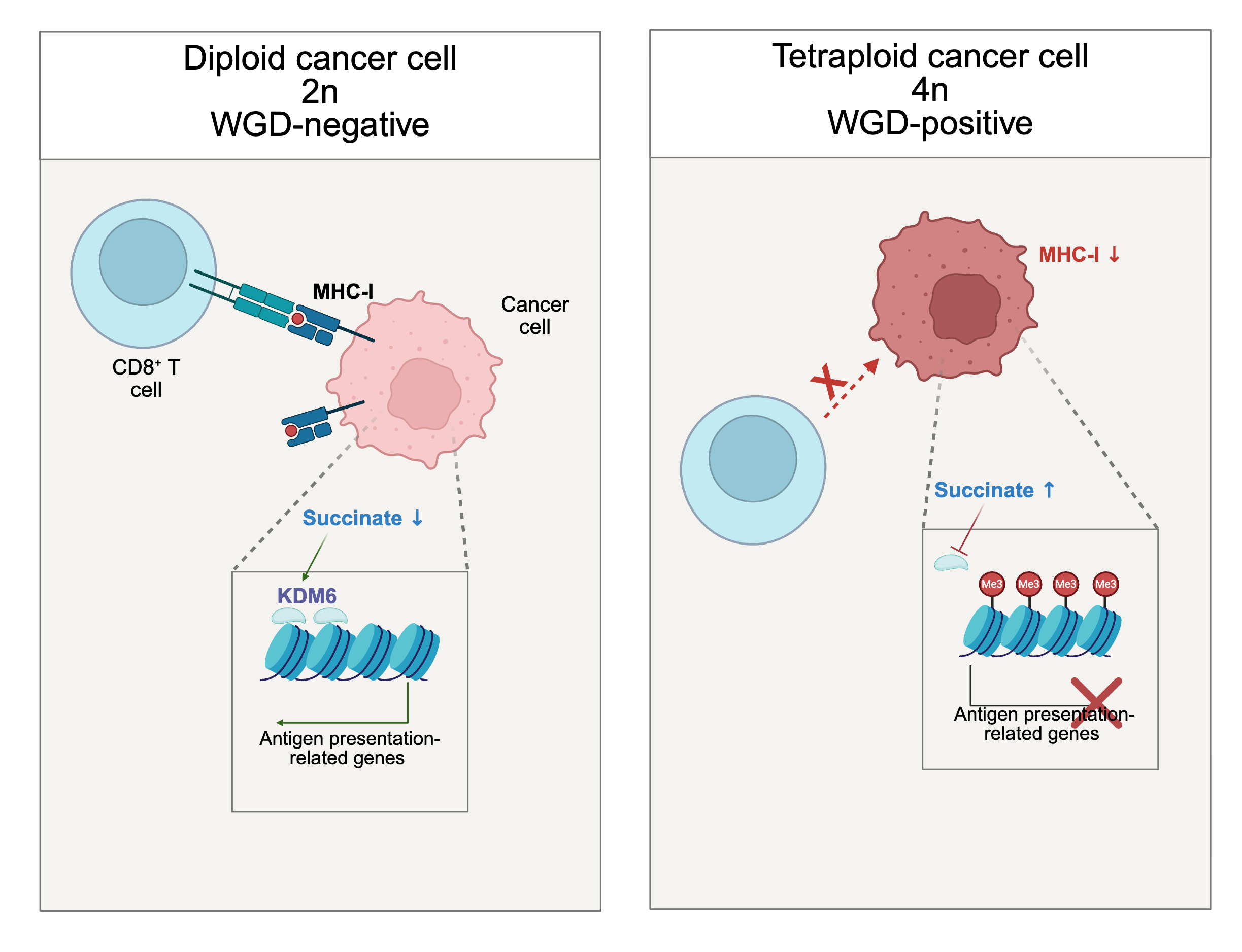
This leads to the next step in immune evasion: antigen presentation, essentially the cell’s molecular “ID badge.” Supporting evidence came from single-cell RNA sequencing of WGD-negative and WGD-positive tumors, which showed that WGD-positive tumors downregulate key antigen presentation genes, including major histocompatibility complex I (MHC-I) and antigen-processing genes.
To further confirm this mechanism, they deleted a component of MHC-I, β2-microglobulin (B2M), in both WGD-negative and WGD-positive tumor cells and implanted them into mice. Loss of B2M allowed otherwise diploid cancer cells to grow as aggressively as WGD-positive tumors, demonstrating that reduced antigen presentation is necessary for immune evasion.
Now, to dig into the mechanism behind diminished antigen presentation, they performed ATAC-seq, which essentially assesses chromatin accessibility and thus epigenetic regulation in these WGD-positive cells. They found closed chromatin states in loci containing these antigen presentation genes, and further confirmed the repressive histone mark H3K27me3 was increased in the WGD-positive compared to the normal diploid breast tumor cells.
To investigate the mechanism behind diminished antigen presentation, they performed ATAC-seq, which measures chromatin accessibility and thus epigenetic regulation. They found closed chromatin states at loci containing antigen presentation genes, along with increased repressive histone marks (H3K27me3) in WGD-positive cells.
Next, they examined the molecular mechanism driving increased H3K27me3. They found altered activity of enzymes responsible for adding and removing these marks. In WGD-positive cells, the activity of H3K27me3 demethylases (KDM6), which normally remove these marks and increase chromatin accessibility, was reduced.
They then considered metabolic changes, since KDM6 enzymes are regulated by the tricarboxylic acid (TCA) cycle. These enzymes are activated by α-ketoglutarate and inhibited by succinate. In WGD-positive tumors, succinate levels were increased, further contributing to reduced demethylase activity and epigenetic silencing.
This was such an elegant paper that is also strengthened by their queries using human patient samples in public databases such as the The Cancer Genome Atlas (TCGA) and METABRIC, along with patient derived 3-D organoids that were either WGD-negative or WGD-positive. Whether this mechanism is relevant in other cancer types is worth investigating. As I am interested in cancer metabolism, how could the metabolic environment, particularly how nutrients and metabolites such as succinate and alpha ketoglutarate in the tumor microenvironment, be altered in the first place to lead to epigenetic changes could be potentially targeted to halt this immune evasion tactic of breast cancer cells? It would also be interesting to investigate how the aneuploid cells metabolism is shifted in response to the genomic event to shape the metabolic environment, potentially through epigenetic regulation of metabolic enzymes or nutrient transporters.
Article title: “Whole genome doubling drives immune evasion by silencing antigen presentation”
Article Reference: Foidart, P., Li, Z., Cai, X., Seehawer, M., Brown, D. D., Tawawalla, A., Baldominos, P., et al. Whole genome doubling drives immune evasion by silencing antigen presentation. Cancer Cell (2026). doi: 10.1016/j.ccell.2026.04.007.
Additional references
Sansregret L, Swanton C. The Role of Aneuploidy in Cancer Evolution. Cold Spring Harb Perspect Med (2017) Jan 3;7(1): a028373. doi: 10.1101/cshperspect.a028373. PMID: 28049655; PMCID: PMC5204330.
Figure created with BioRender